This Is Not a Logo, This Is a Logo
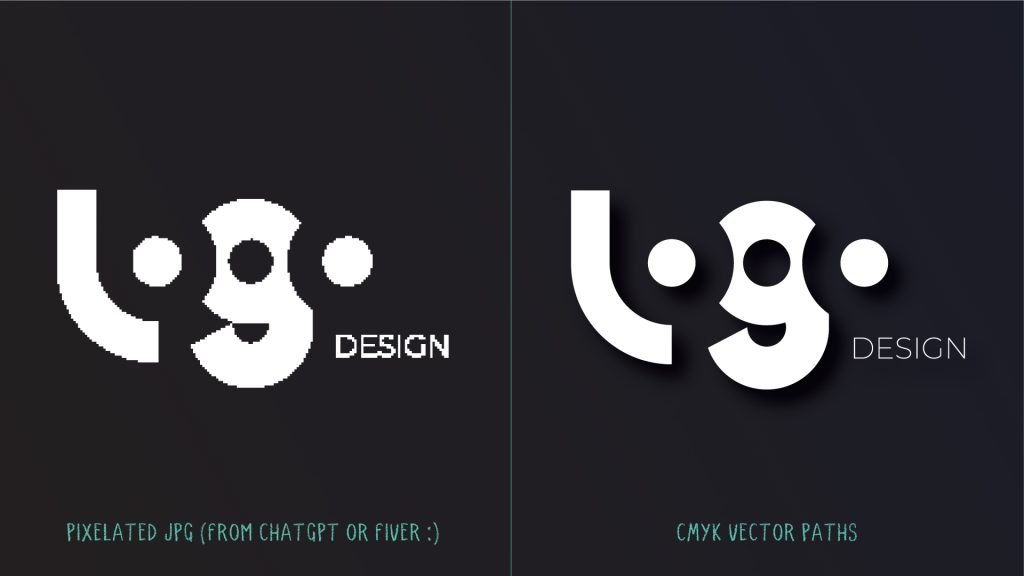
A growing number of businesses are turning to AI-generated logos, unaware that these files are frequently delivered as flat, low-resolution JPGs rather than true vector artwork. The distinction matters more than it may appear: a vector logo scales flawlessly from a business card to a billboard, while a JPG degrades and pixelates the moment it is enlarged. Every logo we design is delivered as clean, scalable vector art — engineered to perform across every application your brand will ever require. Investing in proper construction now prevents a costly redesign later.
For business owners evaluating a custom logo designer near me, this technical foundation should be the first question asked, long before color palettes or typefaces enter the conversation. A logo is not simply an image; it is a functioning brand asset that must perform identically across a website favicon, a vehicle wrap, and a trade show banner. Anything Anymated approaches every engagement as a logo designer company with this principle at its core — construction first, aesthetics second, because aesthetics built on a flawed foundation cannot be salvaged without starting over.
What AI Won’t Do
Artificial intelligence tools have become remarkably adept at generating imagery, but they remain fundamentally unable to produce true vector graphics. AI image generators output raster files — pixel-based images with a fixed resolution — and no amount of post-processing changes that underlying limitation. A common workaround involves running the resulting JPG through an image-trace utility to “convert” it to vector format. In practice, this process rarely succeeds. Image tracing interprets pixel boundaries and attempts to reconstruct paths from them, frequently producing jagged edges, muddied detail, and a file that is technically a vector but visually unusable at scale.
This is precisely why professional logo design services remain indispensable even in an era of accessible AI tools. A designer constructs a logo natively in vector software, building each shape, curve, and letterform with deliberate precision from the outset. There is no reconstruction, no guesswork, and no compromise in quality regardless of final application size. Clients seeking a custom logo design service should ask directly whether deliverables include native vector files — the answer separates a durable brand asset from a temporary placeholder.
QR Codes, No Sir!
A cautionary example illustrates this risk plainly. A client recently used ChatGPT to affix a QR code to a promotional flyer, only to discover after printing that the AI tool had altered the code in the process — silently disabling the hyperlink it was meant to carry. The flyers were already printed. The investment was already spent. The QR code, however, led nowhere.
This outcome underscores a broader truth about AI-generated design work: these tools are not yet capable of preserving the technical integrity of precise, functional graphic elements. A QR code is not decorative; it is a coded instruction set, and even minor alterations can render it inoperable. Businesses investing in a custom branding package deserve assurance that every element — from the primary mark to the smallest functional detail — has been verified, tested, and delivered correctly the first time.
How to Use AI for Logo Design
None of this suggests that artificial intelligence has no place in the branding process. Used correctly, AI can serve as a valuable tool for early-stage concept exploration — generating mood, direction, and inspiration before formal design work begins. The critical distinction lies in sequence and intent. Before rendering a logo, thoughtful consideration must be given to the concept itself: what the mark should communicate, and to whom.
At Anything Anymated, this groundwork begins with a structured discovery meeting, during which we determine which colors, shapes, and conceptual directions will genuinely resonate with your target audience. This process applies equally whether the outcome is a traditional static mark, an animated logo design, a custom animated logo maker-style motion identity, or a cartoon mascot logo built for approachability and memorability. Businesses seeking logo animation services benefit most when the underlying static logo has already been engineered with intention, since motion design is only as strong as the foundation it animates.
For businesses in the Charlotte area exploring Charlotte logo design, this discovery-driven, vector-first approach ensures a mark that performs reliably across print, digital, and animated formats alike — a brand asset built to last, not one assembled by algorithm and hoped into service.
0 Comments